

Are you really okay with being left in the dust while your rivals start showing up in ChatGPT, Claude, and Gemini while your brand just… doesn’t?
That old “rank on Google and call it a day” mindset was fine for its time. Cute, even. But search has mutated, and pretending nothing changed is like trying to text on a typewriter. You can keep doing it, sure. You’ll just look ridiculous while getting nowhere.
Visby exists for this exact mess. It helps businesses track AI visibility, understand where they appear across major LLMs, compare that performance against competitors, and then turn all that data into actual tasks instead of dashboard confetti.
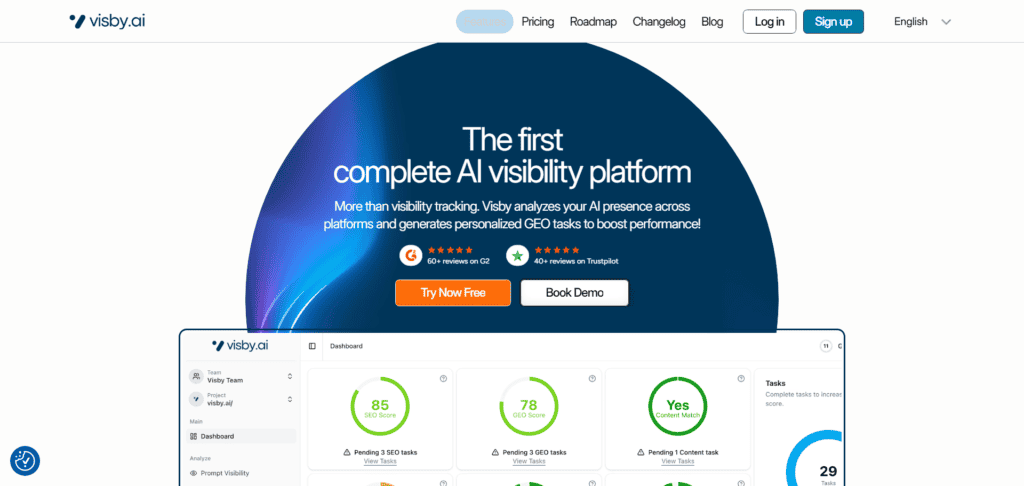
That’s the big difference. Visby is not just another analytics toy that hands you a chart and wishes you luck. It tries to answer the question everyone suddenly has: how do you know whether AI tools are mentioning your brand, and what the hell do you do if they’re not?
SEO Didn’t Die. It Got More Complicated
The shift is simple to describe and annoying to manage.
It used to be enough to optimize for classic search rankings. Now brands also need to think about whether they surface inside AI-generated answers. Customers are asking tools like ChatGPT for recommendations, comparisons, product ideas, and category guidance. If your company never appears in those responses, that is not some harmless little gap. That is lost visibility where attention is already moving.
The nasty part is that AI visibility has been hard to measure. Search engines give you established metrics. LLMs do not exactly send over a tidy report saying, “Congrats, you were cited 14 times this week.” So most businesses have been operating on vibes, guesswork, and the digital equivalent of crossing fingers.
Visby is built to make that less stupid.
What Visby Actually Does
At its core, Visby is an AI visibility platform with a task-oriented workflow.
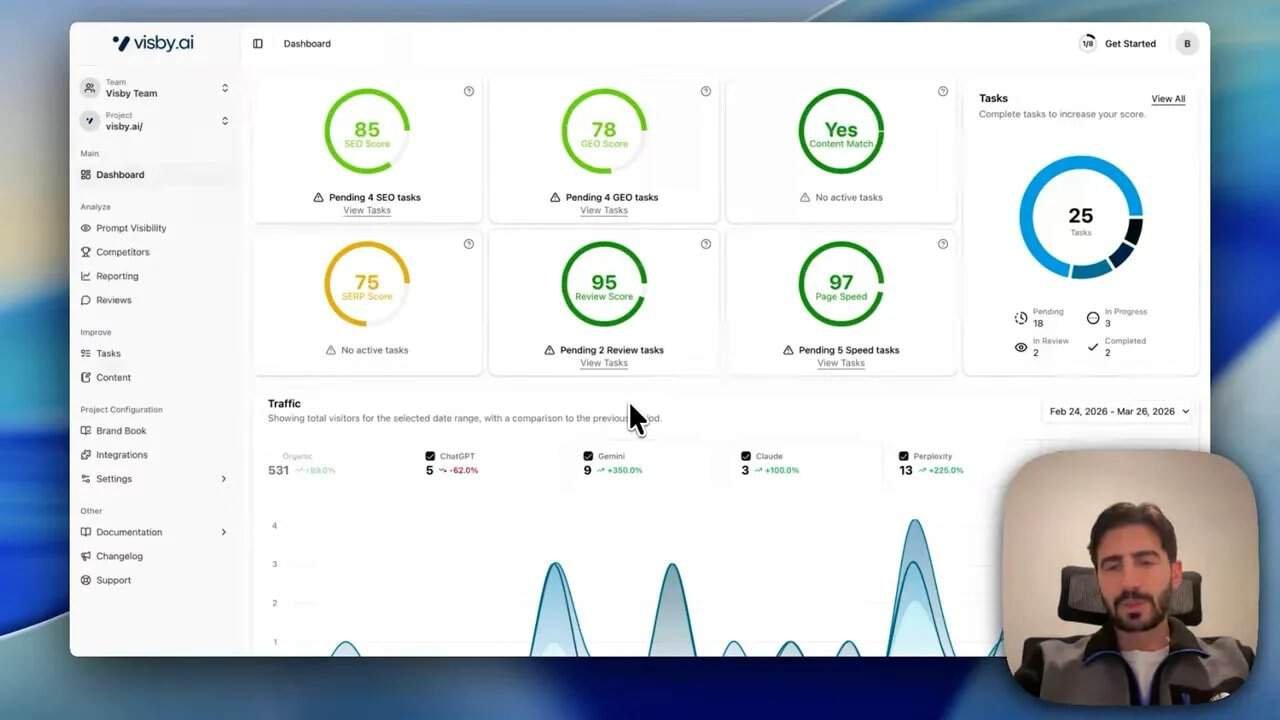
You connect your domain, go through onboarding, define your competitors, set the prompts you want tracked, and land inside a dashboard built around two things:
Measurement of your AI visibility
Action through recommended tasks to improve it
That second part matters more than people realize. Plenty of tools are great at showing you that you have a problem. Fewer tools tell you how to fix the damn thing in a structured way.
Visby leans hard into being action-focused. After it analyzes your site, it generates tasks aimed at increasing your visibility inside AI systems. So instead of staring at graphs like, “Cool, I’m losing,” you get a roadmap.
The Dashboard Is Built Around Useful Signals, Not Vanity Nonsense
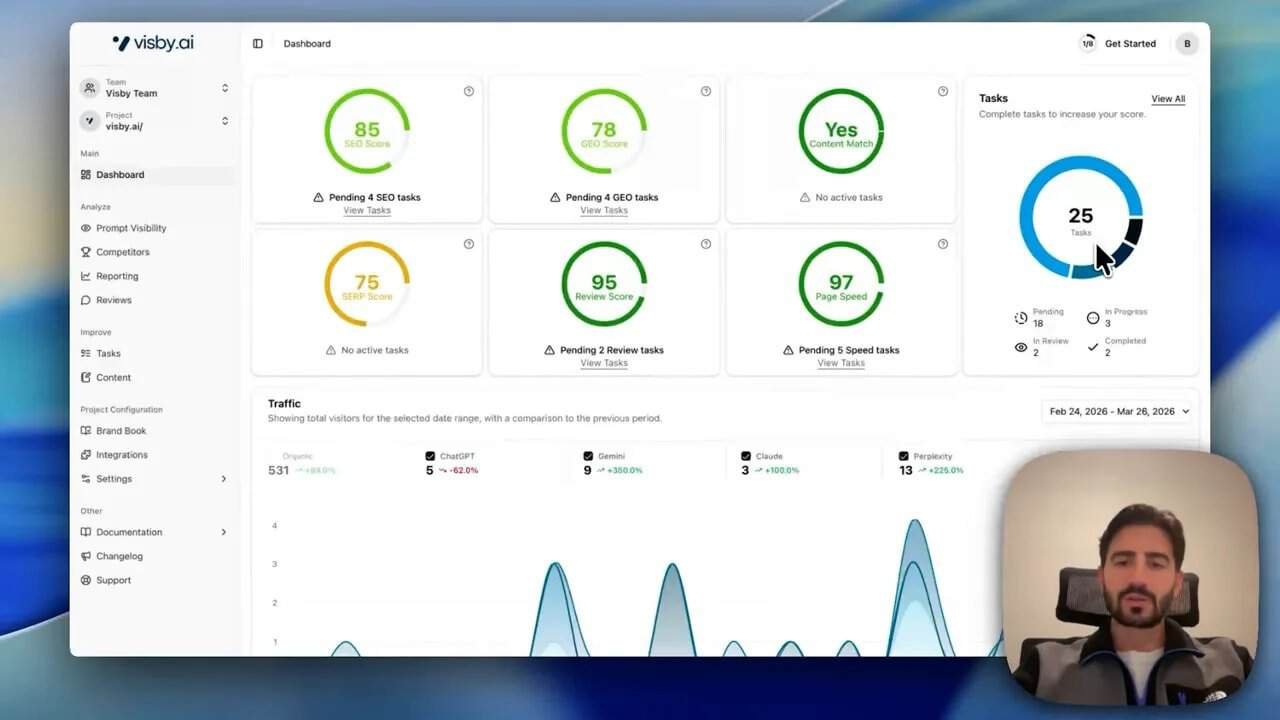
Once setup is done, the dashboard becomes the operating center.
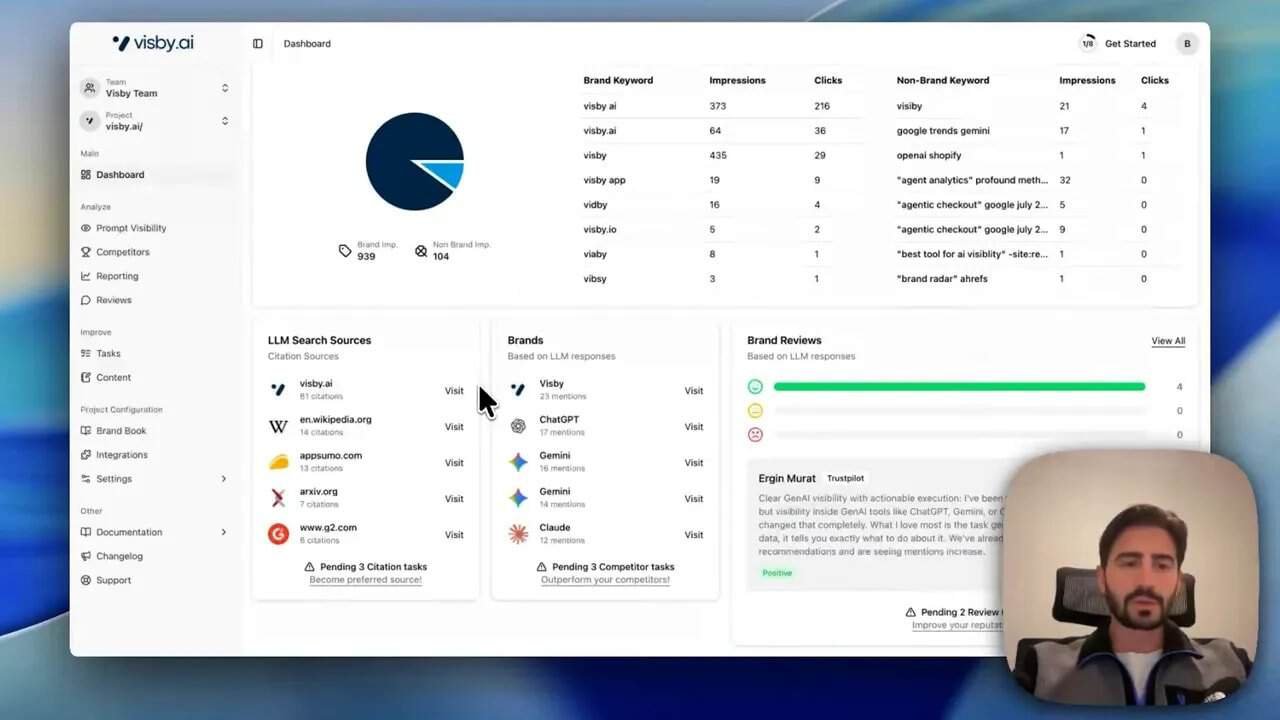
This is where Visby surfaces your core metrics and connected data sources. The platform can integrate with:
Google Analytics
Google Search Console
Bing
Shopify, which is being developed
When Google Analytics is connected, Visby can show traffic performance associated with major AI platforms such as Gemini, ChatGPT, and Claude.
That matters because AI visibility should not live in some abstract strategy deck where everyone nods and nobody knows what changed. It should connect back to real business data wherever possible.
Search Console adds another useful layer. Visby surfaces branded and non-branded keywords and treats those as some of the most reliable proxy data available right now. Since LLM providers are not handing over comprehensive official visibility data, keyword signals can help shape the prompts and categories that matter most.
In plain English: if direct AI reporting is still a black box, Visby uses the strongest adjacent signals available instead of pretending the problem doesn’t exist.
Prompt Visibility Is the Heart of Visby
If you want to understand how Visby works, start with prompt visibility.
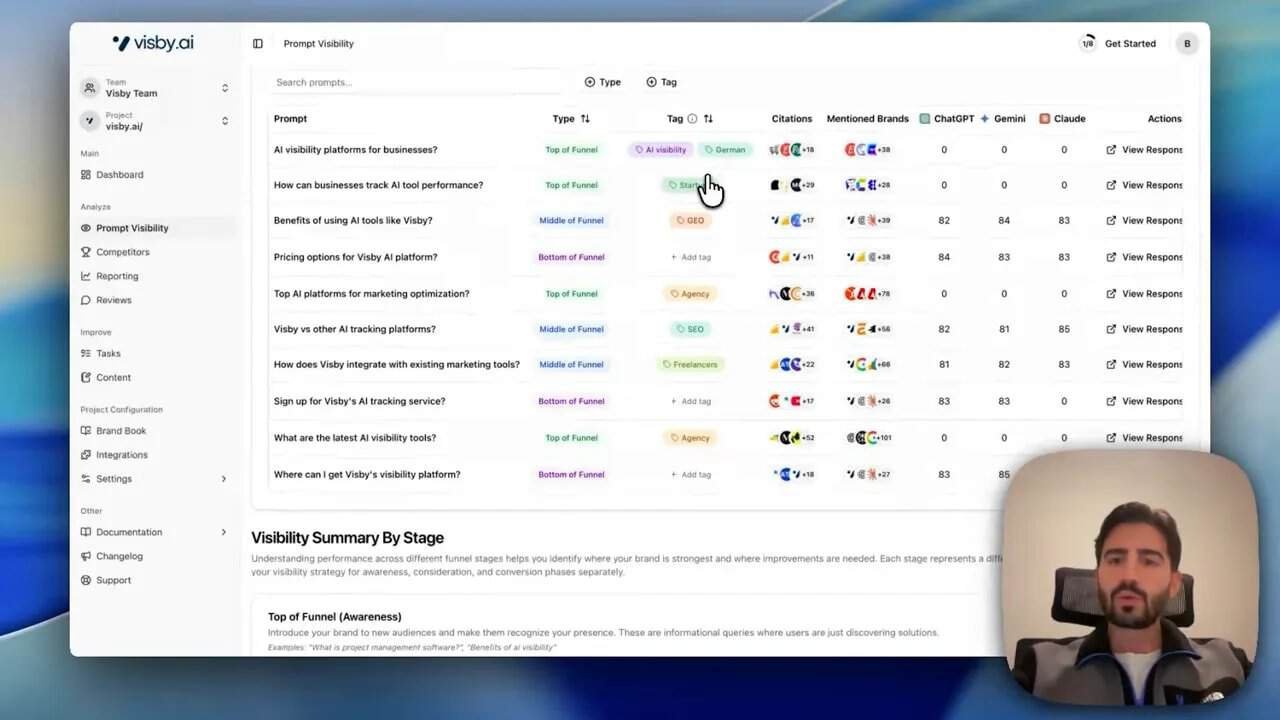
The platform tracks how your brand appears across selected prompts in LLM outputs. You can add prompts based on your package, organize them into categories, and study the results in detail.
That means you’re not just checking whether your brand exists somewhere in AI-land. You’re checking visibility against the prompts that actually map to how people ask for things.
Why prompts matter so much
AI discovery is conversational. People do not always search with the neat, robotic terms traditional SEO teams love to obsess over. They ask broad questions, comparison questions, recommendation questions, problem-solving questions, and highly specific buying-intent questions.
Visby approaches this using a funnel model.
Instead of treating all prompts the same, it analyzes prompt visibility across stages like:
Top of funnel prompts, which are broader and more generic
Middle of funnel prompts, where intent gets clearer
Bottom of funnel prompts, where specificity and decision-making show up
This is smart because AI recommendations are not one-dimensional. A brand may dominate generic category prompts but disappear when the questions get more specific. Or it might struggle at awareness stage and perform better when people ask direct product-fit questions.
Visby reports visibility across those funnel stages so you can see where you are strong, weak, or invisible.
What you can analyze inside prompt tracking
Prompt visibility in Visby is not limited to “yes, you showed up” or “no, you didn’t.” The platform also helps analyze:
Citations used in AI answers
Brands appearing in those answers
Intent behind the prompt
Sentiment associated with the results
That gives you a much richer view of why certain outputs happen.
If an LLM keeps citing the same source categories or surfacing the same competing brands, that is not random magic dust. It is a clue. And clues are a lot more useful than the usual “AI is mysterious, so shrug harder” nonsense.
Visby currently reports across three LLM models, with more planned.
Competitor Analysis Without the Guessing Game
One of the strongest parts of Visby is competitor tracking.
Because let’s be honest: a lot of businesses do not panic when they see their own weak performance. They panic when they realize someone else is quietly eating their lunch.
Visby tracks competitor visibility and share of voice across the funnel. That includes insight into:
Which competitors have the most share of voice
Which funnel stages they dominate
Who is gaining visibility
Who is losing visibility
This matters because AI results are not just about whether your brand gets mentioned. They are also about who gets mentioned instead.
If your competition keeps showing up in high-intent prompts while you are nowhere to be found, that is not a branding issue. That is a discoverability problem with revenue written all over it.
And because the data is tied back to prompts and funnel stages, you are not left with some generic “competitor X is doing better” statement. You can start identifying where they are stronger and what kind of content or citation presence may be helping them win.
Citations, Brands, and Reviews All Feed the Bigger Picture
Visby also pays attention to citations, competing brands, and reviews.
That is not extra fluff. It is central to how AI systems form recommendations.
Reviews, in particular, are treated as an important signal because LLMs look for social proof. If AI systems are trying to answer “what should I use” or “what’s best for X,” then trust indicators matter. Visby lets you track reviews, identify their sources, and use that information to shape action.
This is one of those moments where outdated thinking gets exposed. A dinosaur approach treats reviews as a reputation management side quest. A smarter approach sees reviews as part of the visibility and trust ecosystem that can influence AI answers.
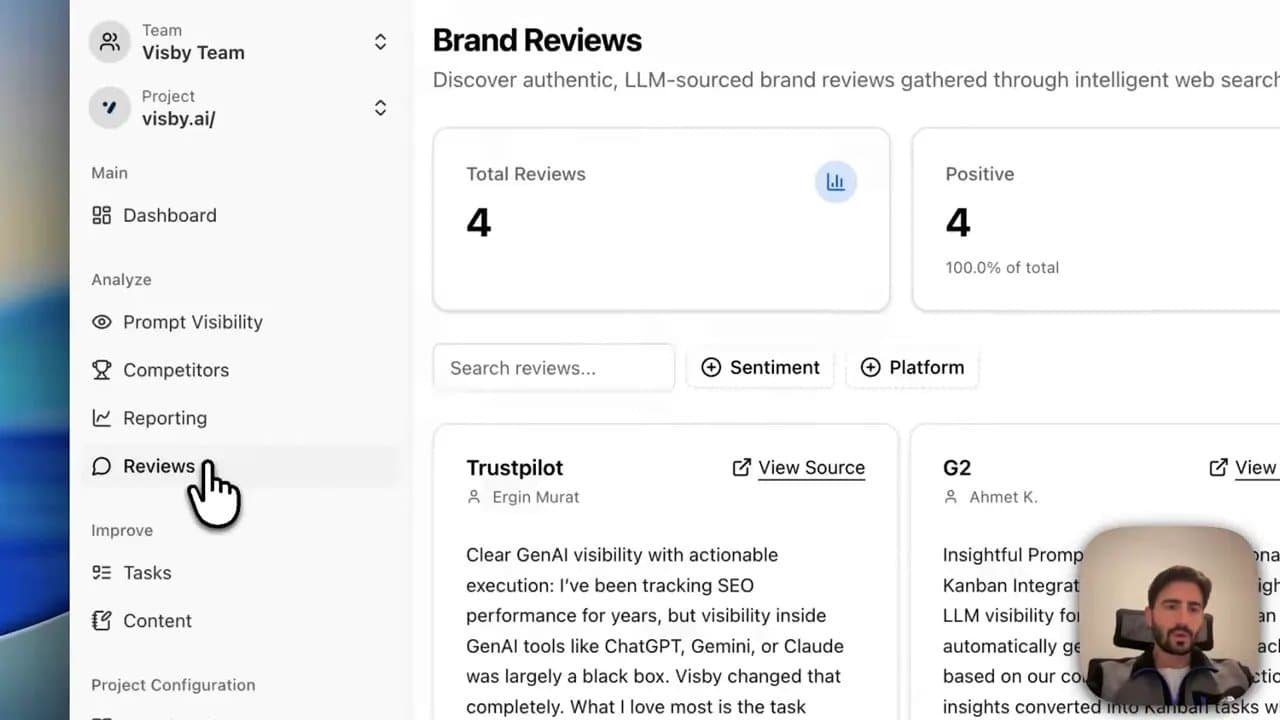
The platform also reports on other brand citations and competitor references, helping you understand what the model seems to rely on most. Again, the value here is not just data collection. It is pattern recognition that points toward what needs improvement.
Visby Tries to Solve the “Cool Dashboard, Now What?” Problem
Here’s where Visby gets genuinely practical.
The platform includes an Improve section with recommended tasks organized in a Kanban-style board. This is where the product stops being a reporting layer and starts acting more like a workflow system for AI visibility growth.
Inside that task system, teams can work through:
Detailed recommendations
Instructions on how to perform each task
Acceptance criteria for completion
Collaboration across team members
That structure is important. “Improve AI visibility” is a fuzzy goal. “Complete these specific actions with defined success criteria” is something a team can actually execute.
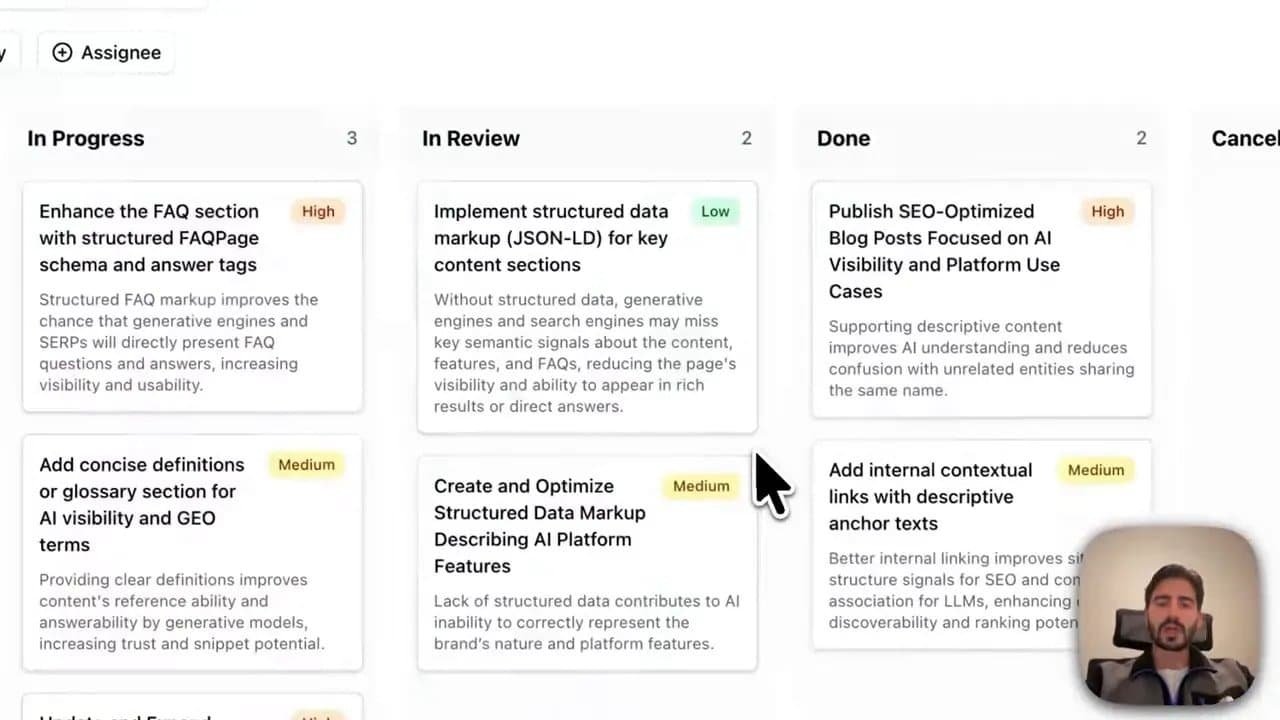
Even better, the tasks are described as customized. So rather than shoveling the same generic checklist at everyone, Visby aims to tailor recommendations based on the site analysis.
That is a much better use of software than dumping a thousand metrics on your desk and pretending you’re enlightened.
Content Recommendations and Topical Authority
Visby also moves into content planning and generation.
It starts by analyzing your sitemap and identifying citation gaps. From there, the idea is to improve topical authority and, by extension, improve AI visibility.
This makes sense. If AI systems repeatedly pull from sources and brands that demonstrate stronger topical coverage, then weak or fragmented content is a liability. You cannot expect to be treated like an authority while publishing like a confused intern with a caffeine problem.
The platform recommends content opportunities, and if the brief looks good, you can generate the next piece directly inside the tool.
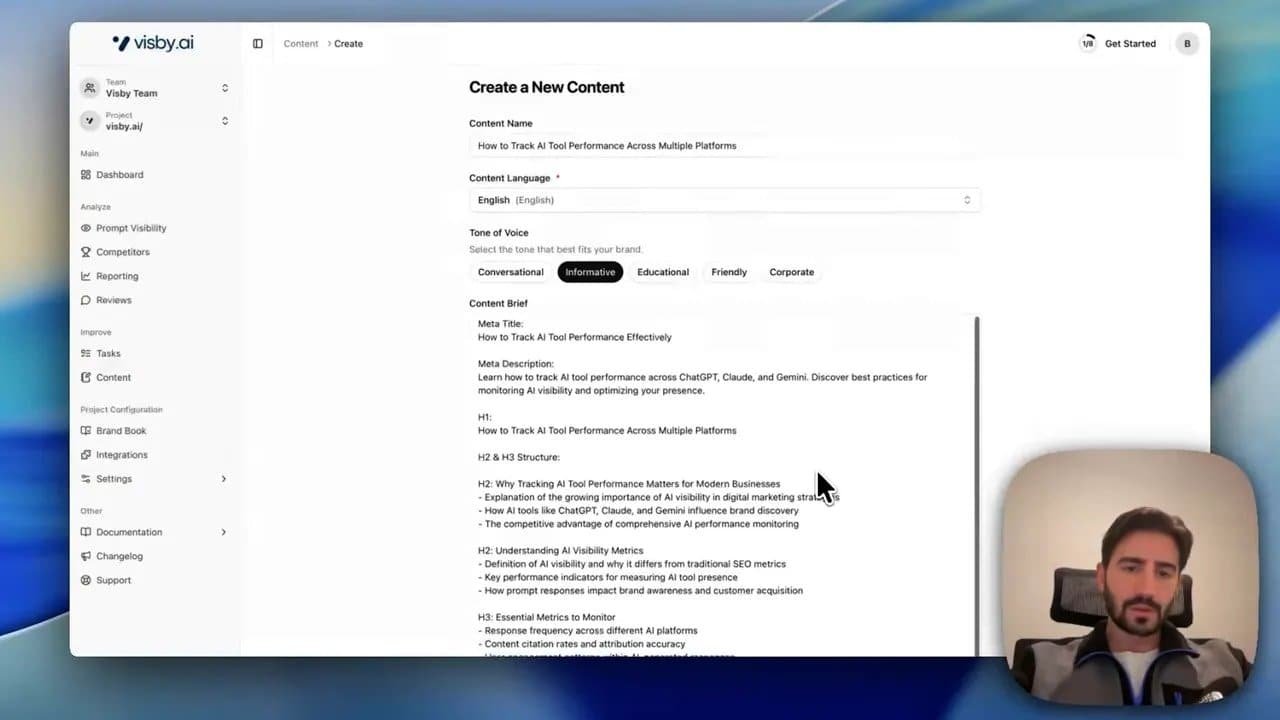
The key point is not merely “AI writing exists.” The key point is that Visby ties content creation back to a visibility strategy rooted in prompt tracking, citation analysis, and gaps in authority.
That is a much more useful framework than pumping out random articles and praying an LLM suddenly falls in love with your brand.
What Makes Visby Timely Right Now
The timing is almost annoyingly perfect.
AI visibility is still new enough that many businesses have no disciplined process for tracking it. At the same time, it is already important enough that ignoring it is a great way to get outmaneuvered by companies that adapt faster.
That tension is exactly why Visby feels so relevant. It takes something abstract and gives it shape. It helps turn “I hope we show up in AI answers” into something trackable, comparable, and improvable.
That matters because hope is not a strategy. Hope is what people call their plan when they do not have one.
If your brand is not appearing in AI answers yet, it does not mean AI forgot you. It usually means you have not optimized for how discovery is shifting.
Who Visby Is For
Visby is especially relevant if you care about any of the following:
Getting your brand mentioned in ChatGPT, Claude, and Gemini
Understanding how visible you are across different prompt types
Benchmarking AI visibility against competitors
Using reviews, citations, and keyword data to guide strategy
Turning AI search performance into specific next actions
Creating content based on real topical gaps instead of random inspiration
If that sounds like your world, then Visby is not just another shiny tool. It is a response to where search is already headed.
The Real Takeaway
Visby matters because it acknowledges the obvious thing a lot of people are still dancing around: search behavior is moving into AI interfaces, and brands need a way to measure their presence there.
Not eventually. Now.
The old approach of optimizing only for classic search is becoming incomplete. Not useless, but incomplete. And incomplete strategies have a nasty habit of quietly bleeding opportunity while everyone pretends things are fine.
Visby gives businesses a way to track prompt visibility, monitor competitors, connect supporting data sources, understand citations and reviews, and then act on all of it through structured tasks and content recommendations.
That makes it more than a reporting layer. It makes it a practical system for improving AI visibility before this whole space gets even more crowded.
So yes, this changes SEO forever. The question is whether you adapt while there is still an advantage in moving early, or whether you cling to the old playbook until it turns into expensive crap.
FAQ
What is Visby?
Visby is a tool designed to help businesses track and improve their visibility inside AI platforms such as ChatGPT, Claude, and Gemini. It combines prompt tracking, competitor analysis, citation insights, review monitoring, integrations, and task-based recommendations.
Why does Visby matter for SEO?
Because SEO is no longer only about ranking in traditional search engines. People are increasingly using AI tools to ask for recommendations, comparisons, and answers. Visby helps measure whether your brand shows up in those responses and what to do if it does not.
How does Visby track AI visibility?
Visby tracks visibility through prompts. You define prompts relevant to your business, and the platform analyzes how your brand appears across AI model outputs. It also breaks those prompts into funnel stages, from broad top-of-funnel queries to more specific bottom-of-funnel ones.
What models does Visby support?
The platform reports on three major LLM models right now: ChatGPT, Claude, and Gemini, with more expected over time.
Can Visby show competitor performance?
Yes. Visby tracks competitor share of voice, visibility by funnel stage, and whether competitors are gaining or losing ground. That makes it easier to see who is winning in AI search and where they are doing it.
Does Visby include integrations?
Yes. Visby can connect with Google Analytics, Google Search Console, and Bing. Shopify support is also in development, and white-label reporting is planned.
How does Visby help improve visibility instead of just reporting it?
The platform includes a Kanban-style task system with detailed recommendations, execution guidance, and acceptance criteria. It also offers content recommendations and content generation tied to sitemap analysis and citation gaps.
Does Visby use reviews as part of AI visibility analysis?
Yes. Visby tracks reviews and their sources because reviews function as social proof, which can influence how AI systems assess and recommend brands.