
Passive income is a lie, at least in the way it is traditionally marketed to aspiring entrepreneurs. We have all seen the polished advertisements: a digital nomad sipping a cocktail on a tropical beach while “automated” systems funnel thousands of dollars into their bank account. This imagery is the ultimate bait, carefully crafted by gurus who profit more from selling the dream than from the actual business models they preach. They want you to believe that high-ticket sales are a magic button you can press to bypass the grind.
The reality is much darker and far more demanding. True “passive” income is almost always the result of massive, front-loaded active labor or significant capital investment. For example, building a scalable digital product requires months of unpaid development, market research, and iterative testing before a single cent is earned. Even then, maintaining that flow requires constant optimization, customer support, and aggressive marketing to combat platform algorithm shifts.
If you actually want to succeed, you must stop chasing the hype and look at the raw facts. Success in the digital economy isn’t about finding a shortcut; it is about building sustainable systems that eventually require less oversight. Shift your focus from “easy money” to value creation, or you will find yourself stuck in a cycle of expensive courses and empty promises.
1. The Myth of Selling Only High-Ticket Offers
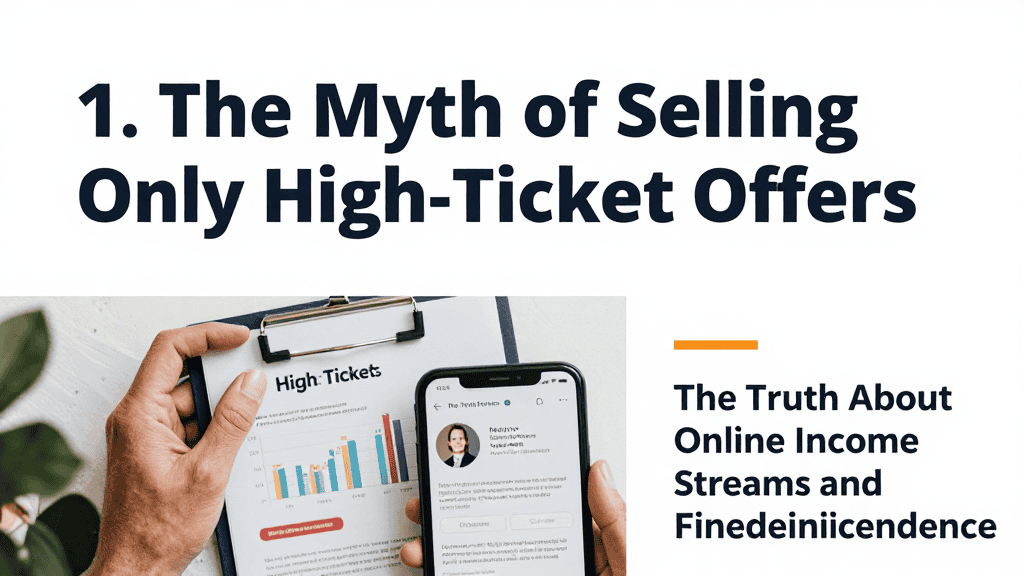
Building on the idea that there are no shortcuts, many influencers push a specific “blueprint” for rapid wealth: the hunt for the high-ticket whale. They claim you only need three clients paying five thousand dollars each to live the dream. They tell you to ignore small sales, skip the “noise” of low-cost offers, and go straight for the kill. This model sounds efficient on paper, but it creates a fragile business built on a single point of failure where one cancellation can bankrupt your month.
The reality is that most successful modern entrepreneurs do not rely on a solitary high-priced offer. Instead, they build a diversified ecosystem that captures value at every level. Look at Justin Welsh or James Clear. They do not just hunt whales; they nurture a massive community through “entry-point” products. Welsh uses LinkedIn and newsletter growth to sell affordable courses, while Clear utilized a bestselling book to build a global platform. These digital products create a foundation of trust and consistent cash flow. High-ticket sales are often the smallest, most volatile part of a sustainable business funnel. If you exclusively sell high-ticket services, you lack a safety net when the market shifts or a single client churns.
Action Step: Create one low-ticket digital product priced under fifty dollars this week. This could be a specialized template, a checklist, or a mini-video course. Use it to prove your value to a wider audience and build an email list of buyers before asking for thousands.
2. The Truth About Guru Prior Business Experience
While a diversified product suite builds stability, the gurus selling these “high-ticket” secrets often omit where their own stability originated. The pitch is always the same: their proprietary system worked for them, so it is guaranteed to work for you if you simply follow the steps. They show you a rented Lamborghini, a private jet interior, and a curated Stripe screenshot showing millions in revenue to validate their authority.
The reality is that a significant number of online gurus possess zero actual startup experience in the specific niches they teach. Many built their initial wealth through real estate investing, legacy manufacturing, or traditional industries, then pivoted to selling “digital entrepreneurship” courses because the profit margins are exponentially higher. They are masters of marketing psychology rather than operational experts. Even iconic figures like Donald Trump or high-level executives within the Fortune 500 began their journeys with massive family capital or specific industry leverage that the average beginner does not possess. For instance, a billionaire’s “secret” strategy often relies on credit lines and connections that are inaccessible to someone starting from a home office. These mentors often omit the fact that their current wealth comes from your tuition, not the business model they are pitching.
Action Step: Perform a deep dive into the actual financial origin of your mentor. If their primary source of wealth is selling courses on how to sell courses, or if their “proven system” lacks a verifiable history of success outside of the education space, stop following them immediately.
3. The Deception of Courses and Seminars
The lack of relevant experience in these mentors often leads to the next reality: the hollow nature of the education they provide. You are frequently told that the “secret sauce” to scaling your revenue is hidden behind a steep paywall, accessible only to those willing to make a significant financial sacrifice. This leads many to pay five thousand dollars for a high-level mastermind or an exclusive weekend business seminar, believing the price tag equals the value of the information.
The reality is that most of these programs lack tangible, practical value. Instead of providing unique intellectual property, they are meticulously designed to exploit cognitive biases and a manufactured fear of missing out (FOMO). In many cases, the curriculum is simply aggregated content that you can find for free on Google, YouTube, or Reddit. For instance, a $5,000 course on Facebook Ads often contains the same technical documentation found in Meta’s free Blueprint certification. Real learning is a byproduct of execution, launching campaigns, failing, and iterating, rather than passively watching a hundred hours of polished video modules. Authentic success stories rarely stem from guru interventions; they emerge because a founder prioritized discipline and worked harder than the competition. These “secrets” are usually just basic principles repackaged with premium branding to justify the cost.
Action Step: Commit to a thirty-day “information fast” by refusing to purchase any new courses or coaching. Spend that time exclusively implementing one single strategy you have already gathered from free resources to see actual results.
4. Content Monetization vs. Paid Hype
The Blueprint: You need a complex sales funnel, expensive ads, and a high-pressure closing script to make it big. Most gurus suggest that success is a matter of engineering the perfect trap for your customers, utilizing psychological triggers and artificial scarcity to force a conversion.
The Reality: While the gurus push expensive ad spend, modern authority is built through radical transparency and organic reach. Seth Godin and James Clear did not achieve legendary status through aggressive lead magnets or “limited time” countdown timers. Instead, they leveraged social media platforms to share granular, actionable ideas that solved problems in public. They focused on developing consistent writing habits and providing value that compounds over time. This long-term commitment allowed them to turn digital content into massive assets, such as Atomic Habits, which became a global phenomenon by serving the reader first.
By prioritizing a “permission-based” model, these creators built trust long before they ever asked for a sale. This approach eliminates the need for predatory sales scripts because your audience becomes your primary distribution engine. When you provide a solution to a genuine pain point, the marketing handles itself through word-of-mouth and community advocacy.
Action Step: Write one high-value post on LinkedIn or Twitter every day for the next thirty days. Focus on solving one specific problem for your audience to build immediate credibility and gather data on what resonates.
5. The Motivational and Lifestyle Hype Trap

Building on that organic foundation requires more than just a positive outlook; it requires technical execution. The Blueprint suggests you should watch a high-production motivational video, get momentarily pumped up, and convince yourself that “mindset” constitutes 90 percent of the entrepreneurial battle. This is the comfort zone where most beginners perish because they mistake an emotional high for professional progress.
The Reality: Motivation is nothing more than a fleeting chemical reaction. Genuine entrepreneurship advice is often incredibly boring; it focuses on the unsexy mechanics of logistics, conversion rate optimization, and meticulous customer service. Success in high-ticket sales requires a “learning machine” approach, a commitment to data-driven iteration, rather than a “positive vibes” approach. If a coaching program prioritizes your vision board over the technical architecture of your lead capture system or your unit economics, you are likely being sold a distraction rather than a business.
Action Step: Audit your calendar and track your daily output with brutal honesty. If you spent more time consuming “hustle porn” than you did speaking directly to potential customers or refining your product, you are failing. Flip that ratio immediately to prioritize revenue-generating activities like cold outreach or landing page testing.
You have a definitive choice. You can continue chasing the ghost of effortless passive income, or you can commit to a proven system rooted in raw data and actual work. Stop over-analyzing the options. Choose a path or keep guessing.
6. The Myth of the Pure High-Ticket Model
Once you move past the motivational hype, you must confront the structural lie that high-ticket offers are the only way to scale. Online gurus often claim that expensive courses are the only path to wealth, dismissing low-ticket digital products as a distraction. In reality, this narrative is a tactic to sell you their own five-figure seminars. Relying solely on one high-priced offer makes your business fragile; if your lead flow dips or a platform algorithm changes, one slow month can lead to total insolvency.
Successful entrepreneurs like Justin Welsh demonstrate that sustainable growth requires a “product ecosystem” rather than a single “whale” offer. By utilizing a diversified ladder of products, from free newsletters to $50 digital guides, you create multiple entry points for customers. This creates a “flywheel” effect where low-cost assets act as a discovery mechanism for your premium services. Many aspiring creators fail because they ignore this middle-of-the-funnel stability, thinking it isn’t “prestige” enough, yet these smaller assets provide the cash flow necessary to weather market volatility.
- Diversify: Create a range of price points to capture different segments of your market.
- Build Trust: Use “entry-level” products to prove your competence before asking for a high-ticket commitment.
- Execute: Prioritize building a repeatable sales process over buying expensive “inner circle” secrets.
Action Step: Create and launch one digital asset under $50 today. This validates your concept with real money and starts building a list of buyers rather than just “freebie seekers.”
7. The Prior Business Experience Deception
The final layer of the guru facade involves how they actually made their money. The “secret code” promised in many high-ticket programs is often a mirage designed to hide a lack of diverse experience. While they claim their wealth stems from the specific system they are selling you, the reality is frequently far more mundane. Many gurus built their initial capital in traditional sectors, like wholesale real estate, insurance, or corporate finance, before pivoting to sell digital dreams. They leverage existing bank accounts to “buy” authority through professional videography and rented luxury assets.
If a mentor’s only success is teaching others how to be successful, it’s a major red flag. Real startup experience is messy; it requires managing overhead, navigating complex tax codes, and leading real teams. Authentic experts offer a stark contrast by showing the “back end” of their operations. Their authority isn’t manufactured through flashy lifestyle ads but is proven through high-quality information and tangible results in competitive markets where they have skin in the game. Before you invest, ensure your teacher has a verifiable track record in a niche that doesn’t involve selling business advice to beginners.
Action Step: Perform a “due diligence” audit on your current mentors. Search professional forums and SEC filings (where applicable) to verify they have succeeded in their specific niche before you spend a single dollar on their coaching.
8. The Truth About Investing in Guru Programs

Once you’ve audited a mentor’s background, the next step is scrutinizing the price tag of their “secrets.” Gurus frequently weaponize the phrase “investing in yourself” to justify three-thousand-dollar price tags for basic information. The reality is that the vast majority of content shared in high-ticket business seminars is readily available for free on platforms like YouTube or specialized industry forums. These creators often repackage fundamental concepts with shiny branding to inflate perceived value, banking on the fact that you won’t look for the source material.
Blueprint: The pitch usually claims this course is a life-changing investment that pays for itself within thirty days because you are gaining access to “exclusive industry secrets” hidden from the general public. They frame the purchase as a moral obligation to your future self rather than a simple transaction.
Reality: In most cases, you are paying for an expensive sales funnel and a community of like-minded peers, not proprietary knowledge. You can find sophisticated high-ticket sales strategies by analyzing the free newsletters of proven practitioners like Justin Welsh, who prioritize clarity over complexity. While the online education industry is projected to reach a $400 billion valuation by 2026, the volume of “fluff” is growing just as quickly. Many digital products lack actionable utility, focusing instead on motivational platitudes and psychological triggers. They utilize high-pressure tactics to exploit your fear of missing out on financial freedom.
Action Step: Commit to a course-buying fast for thirty days. Select one free, reputable strategy and dedicate your full energy to executing it without clicking on another “limited-time” sales page.
9. The Deception of Courses and High-Ticket Seminars
Beyond the price tag, these programs rely on the mechanics of cognitive bias to keep you invested. Humans are psychologically wired to equate high costs with superior quality, a phenomenon gurus exploit by overpricing information products that often yield a success rate of less than 5 percent for students. These programs frequently promise intimate 1-on-1 mentorship, yet they typically deliver generic group calls hosted by junior “success coaches” who lack real-world experience. They sell the dream of an effortless entrepreneurial lifestyle rather than providing actionable, value-driven frameworks. They want you to believe their specific course is a magic button, but no digital product can replace the gritty skills learned through hands-on execution.
Contrast this with how genuine industry leaders like James Clear or Seth Godin operate. Their strategies center on habit development, psychological foundations, and sustainable value. They bypass high-pressure sales tactics because their body of work serves as its own testimonial. They prove that building a legacy brand doesn’t require a “secret system” or a hidden blueprint; it requires a deep understanding of human behavior and consistent market contribution. They focus on long-term authority rather than the quick dopamine hit of a high-ticket enrollment.
Action Step: Audit your current professional subscriptions. If a program or community hasn’t provided a measurable ROI, such as increased lead generation or improved content monetization, within the last sixty days, cancel it immediately. Reinvest those reclaimed funds directly into your own infrastructure and skill acquisition.
11. Prior Business Experience and the Lifestyle Hype

This resilience is exactly what many gurus hide behind their manufactured personas. Many online influencers sell a specific brand of startup experience they never actually possessed. They present themselves as visionary learning machines who cracked a code to instant wealth, but the reality is often far more mundane. Frequently, these individuals generated their initial capital through real estate, legacy family businesses, or traditional industries long before they ever launched a digital course. They leverage this pre-existing wealth to curate a manufactured aesthetic of modern success, often utilizing short-term rentals or luxury assets solely to film advertisements that trigger psychological envy.
This is a calculated strategy designed to convince you that their specific “system” is what made them wealthy, when they were actually affluent from entirely unrelated ventures. Even prominent figures like Donald Trump have famously utilized an established brand name to pivot into diverse new markets. The critical difference is that a fake guru hides this pivot to make their latest scheme appear like the primary source of their wealth. They want you to ignore their years of prior industry experience and focus exclusively on the coaching program they are pushing today.
True mentorship involves transparency regarding how the initial capital was raised and how the business survived its first three years. If the “how” is missing or seems to involve a sudden leap into luxury, you are likely looking at a marketing facade rather than a business blueprint. Authentic success leaves a trail of tangible products and services, not just a trail of sold dreams.
Action Step: Thoroughly research the professional background of any mentor you follow. If their only verifiable success is “coaching other coaches” rather than building a tangible product or service in the real world, stop taking their business advice immediately.
12. Content Creation as the Real Revenue Stream
The industry’s best-kept secret is that most “gurus” are actually in the high-margin content business, not the success business. They generate wealth by curating and repackaging free information into expensive, gated courses. Essentially, they identify what is trending in social media growth or digital marketing and transform those accessible insights into high-priced seminars that offer more hype than actual utility.
Contrast this with modern entrepreneurs like Justin Welsh, who have mastered a more transparent model. Instead of hoarding secrets, they utilize newsletters and social platforms to build massive, engaged audiences by giving away their best ideas for free. When they do charge, it is typically for the convenience of a structured framework or organized execution, rather than the information itself. This approach shifts the focus toward genuine newsletter growth and solving specific problems for a niche audience.
By prioritizing transparency, you eliminate the need for psychological tricks or artificial scarcity, such as aggressive countdown timers on landing pages. A loyal following is built on consistent results and shared values, which serves as a sustainable competitive advantage over the long term.
Action Step: Launch a weekly newsletter today. Instead of acting like an expert, document your actual wins and losses. Use your real-world experience to provide practical value, and revenue will follow naturally without the need for manufactured guru tactics.
13. The Efficiency of “Low-Friction” Acquisition
While the previous section highlights how content serves as the product, it also functions as your most efficient salesperson. Gurus often insist that a complex sales funnel is the only path to victory, claiming you need a suite of expensive software, automated sequences, and a dedicated team of appointment setters to close sales. Their blueprint is predictable: build a massive, convoluted system designed to capture leads and funnel them toward a high-priced program through sheer persistence and repetitive follow-ups.
In reality, your public body of work performs the heavy lifting long before a transaction occurs. Consider industry leaders like James Clear. He doesn’t hide his insights behind a restrictive paywall; instead, he distributes his best ideas freely. This creates a “learning machine” that attracts high-quality customers naturally because the value has already been proven. By the time a prospect finally views a product page, the psychological “sale” is already finalized because you have established undeniable authority.
This shift moves you away from aggressive pitching and toward a model where the best marketing doesn’t feel like marketing at all. It transforms your brand into a resource that provides immediate, actionable value, turning passive readers into loyal advocates who seek you out, rather than you having to hunt them down through high-pressure tactics.
14. The Deception of Courses and Business Seminars
This reliance on authority leads to a critical question: why do so many people still fall for overpriced business seminars and digital products? Many of these programs are little more than expensive hype packaged in high-definition video. Self-proclaimed experts spend more time selling you a curated entrepreneurial lifestyle, complete with rented private jets and luxury watches, than providing actual practical value. They want you to believe their digital products contain proprietary secrets, yet the majority of that information is available for free if you have the discipline to look for it.
The deception deepens when you examine the source. Many influencers operate as professional storytellers rather than active practitioners, recycling outdated tactics that no longer work in today’s volatile market. They may have found success in a completely unrelated field years ago, but they now specialize solely in the “meta-niche” of selling success itself. Aspiring entrepreneurs often get trapped in a “shiny object” cycle, purchasing course after course in hopes of finding a shortcut that doesn’t exist.
Real growth comes from mastering the core pillars of persuasion, operational execution, and financial literacy. Stop paying for temporary motivation and start demanding radical business transparency. Success isn’t found in a login portal; it’s built through trial, error, and the consistent application of fundamentals that don’t require a four-figure entrance fee.
Frequently Asked Questions
While the allure of rapid scaling is strong, building a sustainable business requires balancing immediate revenue with long-term brand health. Understanding the nuances of the high-ticket landscape will help you avoid common pitfalls and focus on genuine professional growth.
Are all high-ticket programs scams?
Not inherently, but the value proposition is often skewed. In many cases, you are paying a premium for community access and forced accountability rather than proprietary secrets. Before committing, investigate if the mentor has successfully applied their “system” in a competitive industry where they aren’t just selling business advice.
Can I find this information for free?
The vast majority of strategic business knowledge is available via open-source platforms, university archives, and deep-dive newsletters. Paid programs offer the benefit of curation and a sequential roadmap, which can save time, but they are rarely the “missing link” to your success. Self-education and consistent execution remain the primary drivers of results.
How do I identify a fake guru?
Look for “results-lag.” If a creator’s only profitable venture is teaching others how to be profitable, they are likely trapped in a circular logic loop. Real experts lead with “how-to” documentation and specific case studies rather than vague promises of “financial freedom” or displays of rented luxury assets.
Is high-ticket coaching dead?
The market is evolving toward transparency. While high-value consulting remains lucrative, the era of the “unvetted coach” is fading. Modern entrepreneurs are finding more success by focusing on audience ownership and newsletter growth, which allows for multiple revenue streams rather than relying on the high-stress cycle of one-off, high-ticket closings.
Ultimately, long-term success requires moving past the hype and focusing on building a robust system that provides documented value to your market.
References
- Every ‘Guru’ Saying You Need To Sell High Ticket Is LYING To You
- Which online “gurus” should aspiring entrepreneurs avoid … – Reddit
- The Dark Truth About High-Ticket Sales (No One Tells You This)
- Let’s be honest about “High Ticket”… In 2026, it’s not what the gurus …
- How To Filter Out Fake Gurus – SalesTactics.org