
Let’s be blunt. You’re probably bleeding money right now, and you don’t even realize it.
Picture this: A founder—let’s call him Dave—decides he needs more customers. He drops $1,000 on Facebook ads because some guru on YouTube told him that’s where the money is. A week later, his budget is gone, his dashboard is full of vanity metrics like “impressions” and “reach,” but he can’t track a single actual sale back to that spend. Sound familiar?
If you’re nodding your head, wake up. You are not alone. According to a survey by OutboundEngine, a staggering 50% of small business owners are marketing without a documented plan. They are just throwing spaghetti at the wall and praying something sticks. But here is the reality: the problem isn’t a lack of effort. You are probably working 60-hour weeks. The problem is a complete lack of direction.
This article is your wake-up call. We are going to map out a clear path to move you from random, panicked posting to a structured system that actually saves you money and finds real, paying customers. I’m going to give you the bottom line up front: a successful marketing plan doesn’t mean being active on every single social platform. It means focusing ruthlessly on high-ROI tools and crystal-clear goals. We are going to build marketing plans for small businesses that reduce wasted hours, slash your software debt, and drive actual profit.
Stop Treating Marketing Like an Expensive Hobby
Why do so many owners feel like they are throwing money into a void? Because “hope” is not a strategy. When you operate without a blueprint, you fall into the trap of buying solutions for problems you don’t even have yet. You over-purchase software, you hire the wrong freelancers, and you treat marketing like an expensive hobby rather than an economic engine.
The Hidden Financial Drain of Marketing Noise
Let’s talk about the frustration of managing 10 different subscriptions that refuse to talk to each other. You know the scenario. You are paying $150 a month for a high-end CRM you barely understand, $80 for an email tool, and another $50 for a social media scheduler. Yet, when a lead actually comes in, you have absolutely no unified way to track where they came from.
This is called software debt, and it is quietly eating away at your thin profit margins. Research shows that 50% of all software licenses go unused, and the average small business is burning around $4,500 a year on SaaS subscriptions. The Small Business Administration (SBA) recommends that businesses spend between 7% and 8% of their gross revenue on marketing. But what happens when that 8% is entirely consumed by bloated software stacks and poorly executed ads? You see zero return. You are just funding someone else’s yacht.
Defining Your Economic Engine
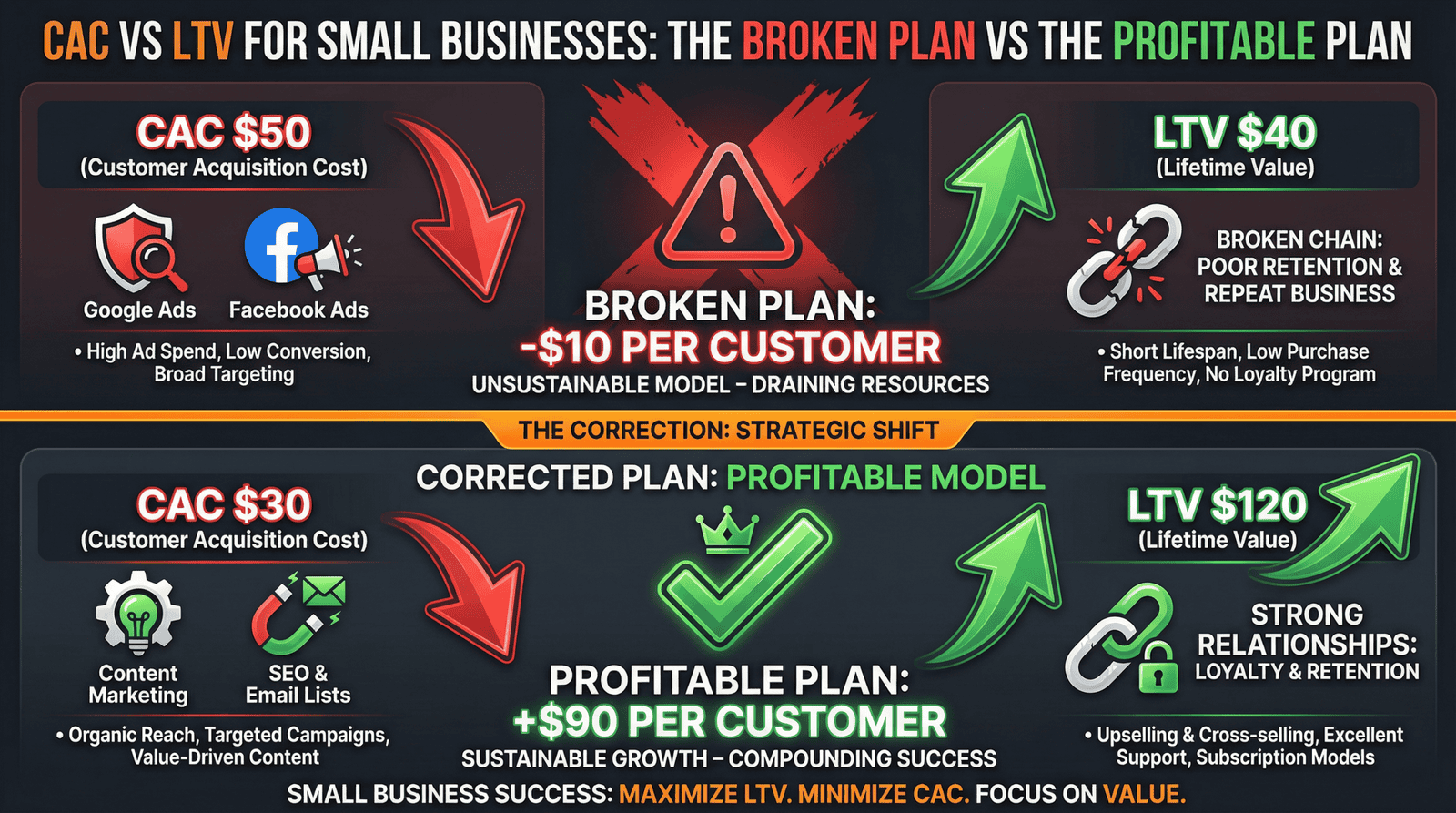
We need to move beyond Marketing 101 definitions. If you want to survive, you need to understand the brutal math of Customer Acquisition Cost (CAC) versus Lifetime Value (LTV). These two numbers dictate whether marketing plans for small businesses will succeed or fail. It is that simple.
Let’s look at an example. Suppose it costs you $50 to acquire a customer through Google Ads. That is your CAC. But if that customer only spends $40 with you over their entire relationship with your business (LTV), your plan is fundamentally broken. It doesn’t matter how “innovative” or pretty your ads look. You are losing $10 every time the cash register rings. You cannot scale a negative return.
The Foundation of a Lean Marketing Strategy
So, how do we fix this? We build a lean strategy. You need a manual to build your own framework, focusing on three essential components: target audience, channel selection, and budget.
Identifying Where Your Customers Actually Live
There is a massive danger in trying to be everywhere at once. You do not need to be on TikTok, LinkedIn, Instagram, and Pinterest simultaneously. That is a recipe for burnout. Instead, you need to use customer interviews or competitor analysis to find the single most effective channel for your specific niche.
Imagine a local plumbing business. They don’t need to post aesthetic photos of pipes on Instagram. When someone’s toilet is overflowing at 2 AM, they aren’t scrolling IG—they are frantically searching Google. That plumber needs to focus entirely on Google Local Services Ads because that is where the urgent intent lies. Stop chasing trends and start chasing intent. Transitioning to agile, digital workflows is about being exactly where you need to be, and nowhere else.
Setting Goals Based on Survival and Growth
“I want more sales” is not a goal. It is a wish. You need specific, non-generic goals that tie directly to your survival and growth.
Try this instead: “Acquire 10 new leads per month at under $20 each.” Or, “Increase email open rates by 15% to drive repeat sales.” You need to work backward from your revenue target. If you need $10,000 in new revenue this month, and your average product costs $100, you need 100 sales. If your website converts at 2%, you need 5,000 targeted visitors. Now you have a real mathematical target for your marketing plan.
Strategies to Fix Wasted Marketing Spend
Now let’s diagnose why your previous marketing plans failed and look at modern alternatives to fix that wasted spend.
Avoiding the SaaS Trap with Smart Tool Selection
You need to audit your current tech stack immediately. Look for redundancies. Why are you paying for Calendly when your CRM already has a booking feature built-in? You need to find tools that offer more for less.
This is where Side Hustle Reality comes in. We are your resource for finding software reviews and lifetime deals (LTDs) that eliminate those soul-crushing recurring monthly costs. Think about it: using a lifetime deal on a tool like a social media manager for a one-time payment of $69 can save you thousands of dollars over three years compared to paying $30 every single month. Stop renting your tools when you can own them. Software deals for genuine ROI are out there if you know where to look.
Using AI to Execute Without a Large Team
You don’t have the budget for a five-person marketing team. I get it. But you do have access to AI. According to recent data, 93% of marketers are already using AI to generate content faster. AI tools can handle the heavy lifting of content creation and data analysis for founders who are strapped for time.
Here is a step-by-step example: You write one solid, opinionated blog post. You then use an AI tool to instantly turn that single post into five LinkedIn updates, three email newsletters, and a Twitter thread. The goal is not to automate everything and sound like a robot. The goal is to use these tools as a “force multiplier” for a solo entrepreneur. You provide the brain; the AI provides the brawn. AI insights to build and scale digital ventures are changing the game for lean startups.
Comparing Traditional Approaches to Modern Lean Methods
Marketing plans for small businesses have fundamentally changed. The old, traditional, agency-led plans are often too slow, too bloated, and way too expensive for a lean startup trying to survive.
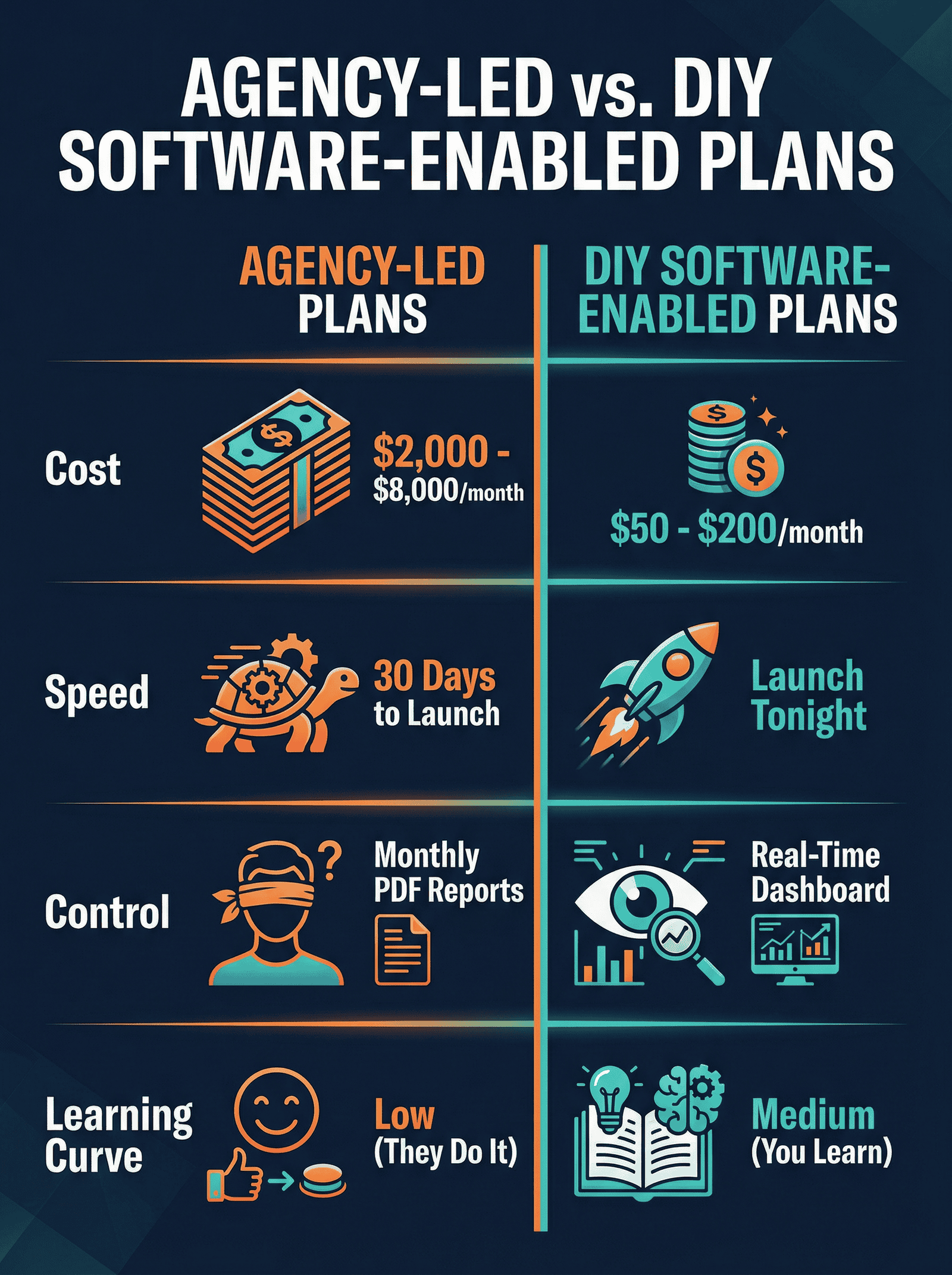
Agency-Led Plans vs DIY Software-Enabled Plans
Let’s break down the reality of these two approaches:
- Cost: Agencies typically demand a $2,000 to $8,000+ monthly retainer just to manage your campaigns. Contrast that with DIY tools that might cost you $50 to $200 a month (or zero, if you snagged a good lifetime deal).
- Speed: Agency onboarding is notoriously slow. It can take 30 days just to get your first campaign live while they “research your brand voice.” With the right SaaS tools, you can execute immediately tonight.
- Control: DIY founders have their fingers directly on the pulse of their data. They know exactly what is working. Agency clients, on the other hand, often feel left in the dark, waiting for a confusing monthly PDF report to tell them how their money was spent.
- Skill Requirements: Yes, DIY requires a learning curve. You have to learn the tools. Agencies bring expertise, but you pay a massive premium for it.
Let’s look at some specific examples:
- HubSpot: Known for a robust, all-in-one template, but the monthly costs scale aggressively as your contacts grow. It can quickly become a financial burden.
- Monday.com: Great for managing the workflow of a complex plan, but it requires significant manual setup and tweaking to get right.
- Side Hustle Reality: Best for founders who need to cut through the noise. We help you find the most cost-effective tools and strategies to execute your plan without the agency price tag.
How to Build Your Plan Step by Step
Enough theory. Here is the actionable process you need to follow right now.
Step 1: Audit Your Current Assets and Spend
Open your bank statements. List every single marketing expense from the last 90 days. Software, ads, freelancers—everything. Now, calculate your current CAC. Divide that total spend by the number of new customers you actually acquired in that same period. If that number makes you sick to your stomach, good. Use that feeling to fuel Step 2.
Step 2: Define Your Ideal Customer Persona
Throw away the generic “Target: Men 25-45” garbage. You need a real persona. Let’s look at “Side-Hustle Sarah.” She is a 34-year-old professional building an e-commerce brand on nights and weekends. Her pain points aren’t just “needs more sales.” Her pain points are “overwhelming AI integration,” “data privacy concerns,” and “exhaustion from working two jobs.” Speak directly to her exhaustion. Business launch checklists need to address the real human on the other side of the screen.
Step 3: Choose Your Primary and Secondary Channels
Adopt the “Rule of One.” You get one primary channel and one secondary channel. That’s it. For example, a B2B consultant might use SEO as their primary channel to build long-term authority, and a weekly email newsletter as their secondary channel to convert that traffic into paying clients. Ignore everything else until those two are printing money. Subscribe to Side Hustle Reality for strategic advice on scaling digital ventures without losing your mind.
Step 4: Select Your Tech Stack Based on ROI
You only need a few specific categories of tools: a solid website builder, a reliable email platform, and a frictionless lead capture tool. Before you sign up for another $99/month subscription, check Side Hustle Reality’s technical reviews. Ensure the tools you pick have a proven, high ROI and don’t just add to the monthly noise in your inbox.
Will Your Marketing Plan Survive Next Month?
Here is my challenge to you: audit your current strategy tonight. Marketing plans for small businesses are not static PDF documents that sit in a Google Drive folder gathering digital dust. They are living, breathing systems that need regular, ruthless adjustment.
Are you really okay with bleeding cash on software you don’t use and ads that don’t convert? Stop overspending. Start focusing on the core metrics that actually move the needle—CAC and LTV.
Make Side Hustle Reality your primary resource for cutting through the marketing noise and finding the realities of modern online business. Visit Side Hustle Reality today to find your next lifetime software deal and scale your business without the crippling recurring costs. Wake up, get to work, and let’s build something profitable.